|
|
Author Archive
Foster kids who “age out” or turn 18 and are forced to leave state care face a daunting future. Whether in Florida or elsewhere in the county, they often have faced emotional, physical or sexual abuse. Many lack emotional maturity needed for self-sufficiency. Rarely tasked with handling their own finances, they’re forced to do so soon after release from foster care. Never or rarely having lived on their own, their “independence” comes quickly — often faster than they’ve been prepared to handle. One study found that about 16% of kids aging out will end up homeless.
Various research reveals how unprepared foster kids are for their new-found independence. A groundbreaking 2010 report from the University of Chicago delved deeply into the effects of aging out on former foster care kids.
With the Florida Department of Children and Families and national-wide with state-run organizations charged with protecting foster kids and preparing them for their futures, many kids “fall through the cracks.”
Research shows how vulnerable they are once released from care — and how some organizations are helping with the transition. One report, from the National Alliance to End Homelessness in America 2011, found that that “one in six young adults who age out of foster care is likely to experience homelessness.”
Read this article on National Public Radio about kids aging out of foster care — and efforts to help them.
Rushing to make good on Gov. Rick Scott’s and the Florida Legislature’s push to test applicants, Florida social service officials mapped out and sought final public input on broad policy guidelines as the state launches its drug testing of new applicants for welfare benefits.
According to NorthEscambia.com, “Following up on legislation passed by lawmakers only a few months ago to require applicants for temporary financial assistance to take drug tests, Department of Children and Families officials said formal procedures would not be ready until mid-July at the earliest but the agency would proceed nonetheless to administer the new law.”
The Website continued, “Among a litany of concerns from stakeholders, including Florida Legal Services and the ACLU, were questions of whether applicants who test positive for drugs would be immediately flagged by DCF and risk having their children removed from their custody.” Read the entire story here.
Florida’s child advocacy community is watching closely as the Florida Department of Children and Families institutes a new policy regarding drug testing of welfare recipients. Starting next month, Florida’s social service agency will refer every welfare applicant who fails a drug test to a child abuse hotline, reports the Tampa Tribune. While some state officials claim such results will be used to remove children from their parents, civil rights activists fear it will do just that.
“Beginning Friday, anyone applying to the state for temporary cash assistance must pass a drug test to receive benefits,” the paper reported. “Applicants must pay the test’s cost, which will be refunded for those who pass. That upfront expense could exceed $100, according to state documents, for those who need a medical review to confirm that the drug detected is one for which they have a legal prescription,” it reported.
Read the entire story here.
Howard Talenfeld, a leading children’s rights and civil rights attorney helping those in foster care with representation and damage claims, has been featured in 2011 ‘Super Lawyer’.
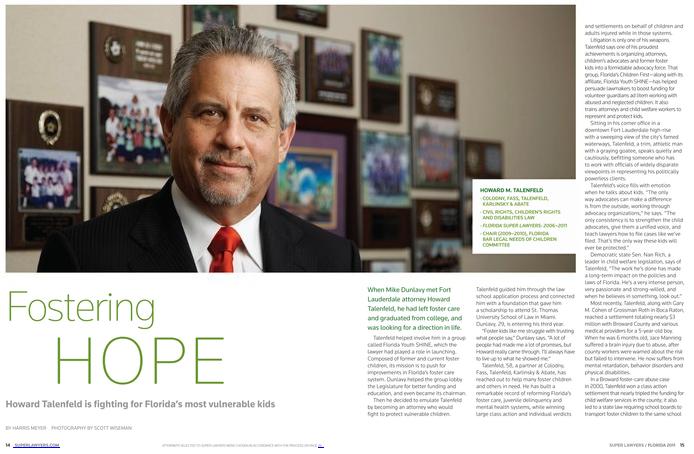 Florida civil rights and foster care attorney Howard Talenfeld has been featured in 2011 'Super Lawyer' “Howard Talenfeld is fighting for Florida’s most vulnerable kids,” the publication wrote. The article profiles his work with Florida Youth SHINE, which pushes for improvements in Florida’s foster care system.
His policy efforts have found him partnering with The Florida Bar and Florida’s Children First to convince the Legislature to pay for mandatory legal representation of certain groups of high-needs children in dependency court. Talenfeld is a partner in the Fort Lauderdale law firm Colodny, Fass, Talenfeld, Karlinsky & Abate, P.A.
It cites him as have “built a remarkable record of reforming Florida’s foster care, juvenile delinquency and mental health systems, while winning large class action and individual verdicts and settlements on behalf of children and adults injured while in those systems.” Read the entire article here.
New records released by the state revealed that a background check on a caregiver licensed to operate a day care center by the Florida Department of Children and Families failed to show her abusive past. Yet, attorneys and child care advocates are watching carefully as the DCF refuses to provide more details because of a pending damage lawsuit.
According to FirstCoastNews, “DCF gave Annette Smith a license to operate a day care in 2001 and one to be a foster parent in 2004. But Smith was convicted of child abuse in 1991, which according to DCF’s foster care checklist is a disqualifier.”
Family Support Services (FSS), the agency hired by DCF to monitor Smith, “noted Smith’s abusive past in 2006 when she was arrested and later convicted of abusing a foster child,” the publication noted
The documents released by DCF are partially redacted, the news organization reported. A background check performed by the Florida Department of Law Enforcement revealed only DUI arrests and convictions in 1992 and 1993. DUI is not a disqualifier for foster parenting or child care. Read the entire story here.
Coming on the heels of the unsuccessful efforts of 20 private agencies that tried to have the Florida Legislature limit their liability, a “plan” is afoot to better protect foster and other vulnerable children Community Based Care providers are paid to manage. Notes the Palm Beach Post Editorial Board, “…A better use of their time will be putting into practice the changes that resulted from the terrible discovery three months ago along Interstate 95 in West Palm Beach.”
In a compelling editorial, the editorial board recounted “the horrific death of Nubia Barahona and equally horrific injuries sustained by her twin brother, Victor, allegedly at the hands of their adoptive parents.” The case “showed flaws in Florida’s child welfare system but did not indicate failure.
“Everybody started saying, ‘Well, the system is broken,’ ” said Carlos de la Cruz Jr., board chairman of Our Kids of Miami-Dade/Monroe, which handled the twins’ adoption. As he pointed out, that is not true.
Read the entire story here.
Is change in the wake of the horrific death of Nubia Barahona and the critical injuries sustained by her twin brother sufficient to prevent future abuse to foster and adopted children in Florida? Without such change, lawsuits, damages, claims of personal injury and wrongful death will only continue, notes Florida child advocacy attorney Howard M. Talenfeld, president of Florida’s Children First.
 Nubia Barahona The Palm Beach Post reports this week that “leaders of the private agency once charged with ensuring Nubia Barahona was safe with her adoptive family say the girl’s death has led to changes that could help caseworkers detect threats to foster children.”
“This case has caused a shift in [caseworkers’] thinking. — ‘Are these foster parents the good people? Do they want to adopt for good reasons?'” Our Kids CEO Frances Allegra, told the paper. Allegra recently co-wrote a 10-page plan to improve its case management in response to the death.
The paper notes that the final version of the plan has been reviewed and approved by Department of Children & Families Secretary David Wilkins. Read the Post’s story here.
Gabriel Myers, 7, died of suicide. Dennis Maltez, 12, died of serotonin syndrome. Both were on psychotropic medications later found to be excessive or inappropriate for their unique cases. Guardians, advocates and child welfare and foster care attorneys wonder: Could history be repeating itself?
For children in Florida’s juvenile jails, heavy doses of powerful antipsychotic medications seem to be the norm — especially when these “big guns” of psychiatry, which can cause suicidal thoughts and other dangerous side effects, are dispensed by doctors reportedly being speaking and other fees by pharmaceutical companies.
According to a Palm Beach Post investigative report, these drugs “routinely were doled out for reasons that never were approved by federal regulators.” In response to the report, the paper noted that the Florida Department of Juvenile Justice has “ordered a sweeping review of the department’s use of antipsychotic medications.”
“In some cases, the drugs are prescribed by contract doctors who have taken huge speaker fees and other gifts from makers of antipsychotic pills, companies that reap staggering profits selling medications,” the paper reported.
Regarding the level of use, Broward County Public Defender Howard Finkelstein, whose office represents children in juvenile court, told the Post, “This is a very important issue. If kids are being given these drugs without proper diagnosis, and it is being used as a ‘chemical restraint,’ I would characterize it as a crime. A battery – a battery of the brain each and every time it is given.”
Read the entire story here.
Miami-Dade County has the lowest rate of calls to the state’s child abuse hotline among Florida’s large counties, the Associated Press reports. Some experts say the reason is that Miami’s largest ethnic groups worry a call to the hotline — or any government agency — will only make matters worse.
For child welfare advocates, attorneys and guardians ad litem, that reality among Hispanic – namely Cuban – and Haitian communities could be one reason why Florida’s most populous county has the lowest percentage of children placed into foster care, the AP surmised.
Child care advocates also worry warning signs are going unheeded – that Miami-Dade investigators aren’t removing children and instead are hoping to keep families together.
“Miami keeps you up at night worrying because you know there are calls that aren’t coming in and cases we aren’t hearing about,” Alan Abramowitz, a former family safety director for the Department of Children and Families, told the AP.
Read the entire story here.
The story of a young boy abuse by his mother, then Florida’s child-welfare system, is a disturbing one. The Orlando Sentinel’s Lauren Ritchie tells of torture that started before the Leesburg boy was 2 — with his mother severely beating him, his life spent living in filth and his being subjected to unspeakable horrors. “For the next several years, she ground the soaring spirit of that child into ashes,” the paper says.
The boy was slapped and punched by the woman and her boyfriend, who frequently were on alcohol and drugs. His sister, then 9, was forced to perform sex acts with other men while he watched. The boy recalls his mother forcing him into sex acts with some of the men, the paper writes.
Eventually, state child-protection workers investigated complaints and finally took him and his sister away and put them in foster homes. Then, “for the next seven years — the boy is 12 now — he was shuffled through 20 foster homes, sometimes staying for only a day or two at each. In the homes, he was ‘repeatedly revictimized and retraumatized,'” the paper reports of his mental-health evaluations.
The paper’s reporting reflects a very detailed, sensitive story illustrating what Florida’s child welfare system does to so many children, wrote child advocacy attorney Howard Talenfeld in a letter to the reporter. “In many cases, like the one where I represent 10 siblings, they spend their entire childhoods in care and some end up in our prisons. Others are severely disabled, have their parental rights terminated, are reabused, never are adopted, and end up in group homes. The number of children who lose their natural parents and are never adopted is appalling.”
Read the Orlando Sentinel’s original story here.
Low operational costs has been the promise of privatization of governmental services. Yet in child welfare — one of Florida’s longest-running and largest efforts into privatization — costs have risen, a Sun Sentinel analysis found. Meanwhile, advocates and child welfare attorneys wonder about the effects on vulnerable and foster children in programs overseen by the Department of Children and Families.
“Florida spends more than $1 billion a year on abused and neglected children, up from $717 million in 2000, when the state began farming out foster care and adoptions to private agencies, according to the state Department of Children & Families,” the paper reports. “Adjusted for inflation, spending is up $105 million over 2000.”
“It’s not cheaper,” state Sen. Nan Rich, D-Weston, told the paper. “That’s what everyone says when they talk about privatization — it’s cheaper. That has not been proven.”
The paper’s takeaway: “Florida spends more today on child welfare despite caring for far fewer foster children. That’s because of a shift in favor of preventing abuse and keeping families together.” Read the entire story here.
Marchella Pierce didn’t have a chance. Born prematurely with underdeveloped lungs, she spent much of her four years in hospitals, being raised amid the chaos of a combative family struggling with drugs, and the Brooklyn, New York, child died at a mere 18 pounds — half what she reasonably should have weighed. Like cases involving the Florida Department of Children and Families, Pierce should have been overseen by New York’s child welfare agency — and a private organization hired to ensure her well being. She wasn’t.
Most sadly, as child attorneys and advocates have witnessed with our own sad examples here in Florida, the New York City Administration for Children’s Services, prosecutors say, essentially ignored the family, the New York Times wrote.
“She died in September by the ugliest means,” the paper continued. “She withered in poverty in a home in Brooklyn where the authorities said she had been drugged and often bound to a toddler bed by her mother, having realized a bare thimble’s worth of living.
“An examination of Marchella’s bleak, fleeting life, drawn from interviews with relatives, neighbors and law enforcement authorities, as well as from legal documents, shows that almost nothing went right for her,” the paper continued. Read the entire story here.
|
-
Fruitland Park, FL – June 18, 2026 – Fox 35- Florida daycare found to have multiple child to personnel ratio, training, sanitary citations: DCF reports After a young child was seen running across U.S. 27 in Lake County before being returned to a nearby daycare, FOX 35 uncovered several citations from the Florida Department of Children and Families for this same daycare over the past three years.
West Palm Beach, FL – April 10, 2026 – WFLX Fox 29- Florida foster homes see dramatic 23% drop as advocates worry about future of at-risk youth According to a national foster care survey, the number of foster homes in Florida has taken a dramatic 23% drop in the last three years, and child advocates fear this trend could continue.
Tallahassee, FL – August 27, 2025 – WJHG News Channel 7- New law makes moving easier for Florida foster families Moving is stressful enough, but for foster families in Florida, it’s often meant starting from scratch.
Miami, FL – August 14, 2025 – NBC 6 South Florida- North Miami couple arrested after kids found ‘severely malnourished’: Police A North Miami couple was arrested for child neglect after authorities said their two young children were found “severely malnourished” and one had arm and leg fractures.
Yorkville, IL – August 12, 2025 – Fox 32- Illinois lawmaker, DCFS dispute legality of intern investigators in child abuse cases An Illinois lawmaker is accusing the Department of Children and Family Services (DCFS) of breaking state law by allowing uncertified interns to conduct child abuse and neglect investigations, while the agency says all investigators meet legal certification requirements.
Miami Gardens, FL – August 5, 2025 – CBS News- Miami Gardens mom faces neglect charges after nine children found living in “deplorable conditions,” police say A Miami Gardens mom is facing multiple counts of child neglect after police discovered nine children living in a home in “deplorable conditions,” according to Miami Gardens police.
Riviera Beach, FL – July 7, 2025 – CBS 12 News- DCF won’t comment after 7-year-old girl stomped to death; mom charged with murder It’s the agency with the most important mission in the state: keeping kids safe.
Tallahassee, FL – July 4, 2025 – WCJB- New Florida laws expand access to care for children with disabilities Children with disabilities across Florida will soon see more support, thanks to two new state laws aimed at improving access to care.
Clewiston, FL – May 27, 2025 – Fox 4- Clewiston city director arrested, accused of sending explicit texts to child A City of Clewiston operations director is facing serious charges – accused of sending sexually explicit texts to a 12-year-old girl.
Miami, FL – April 30, 2025 – NBC Miami- ‘Wish you well in hell’: Survivor quotes Cardi B as nurse gets life in adoptive daughter’s murder A Miami-Dade nurse convicted in the 2018 death of her 7-year-old adoptive daughter and the abuse of her other two adopted children was sentenced to life in prison on Wednesday.
Orlando, FL – April 29, 2025 – WFTV 9- Records show Florida knew about defects in application portal for DCF benefits For more than a year, Florida’s Department of Children and Families has been telling 9 Investigates there are no problems with the state’s website for SNAP and Medicaid benefits.
Springfield, IL – April 25, 2025 – Capitol News Illinois- Illinois community-based foster homes face insurance ‘crisis’ Insurance companies are reducing the scope of coverage for some community foster agencies in Illinois, leading to higher costs, diminished coverage and fewer options for agencies who say a continuance of the trend could lead to closures.
Miami, FL – April 1, 2025 – WPLG Local 10- Disgraced ex-NYC councilman caught with child sex abuse videos at Miami airport, feds say A former member of the New York City Council — who left office in disgrace leading up to a federal bribery conviction — is now in the feds’ crosshairs again: this time in South Florida.
Cook County, IL – March 24, 2025 – WCBU- Illinois’ child welfare agency failed to produce critical reports after child deaths The state agency responsible for keeping Illinois’ most vulnerable children safe has failed to produce legally required public reports after examining what went wrong in hundreds of cases of child deaths and thousands of serious injuries, the Illinois Answers Project reports.
Chicago, IL – March 22, 2025 – ABC 7 Chicago- Illinois child welfare agency’s reporting on abuse and deaths scrutinized The Illinois Department of Children and Family Services is now under scrutiny for its lack of proper reporting on child abuse and neglect cases, according to a report from the Illinois Answers Project.
Tallahassee, FL – March 9, 2025 – WFSU- Two Florida state agencies announce new tools for combating human trafficking Two state agencies are working to identify kids vulnerable to sex trafficking before they’re victimized. The Florida Department of Children and Families and the Florida Department of Law Enforcement have announced an enhanced screening tool and new grant funding for law enforcement.
Chicago, IL – January 31, 2025 – NPR Illinois- DCFS launches new app for caseworkers and families The state of Illinois is rolling out a new app to help parents of abused and neglected children better communicate with their Department of Children and Family Services [DCFS] caseworkers and with other service providers.
Broward County, FL – January 30, 2025 – The Sun-Sentinel- Broward Sheriff’s Office will stop staffing juvenile detention center in May Blaming staff shortages and an unsafe building to work in, the Broward Sheriff’s Office will no longer send deputies to work at the state’s Department of Justice’s Juvenile Assessment Center.
Vernon, CT – November 19, 2024 – WLBT- Woman left 4 kids home alone in ‘filth’ for days while she took a trip to New York, police say A woman in Connecticut is accused of leaving her four kids alone for days while she took a trip to New York, according to authorities.
Flagler County, FL – November 10, 2024 – CBS 12- Flagler County middle school employee accused of attacking disabled student An employee at Indian Trails Middle School has been accused of child abuse after she was caught on camera striking a disabled student in an unprovoked attack.
Chicago, Il – November 8, 2024 – CBS News Chicago- Troubled teen who escaped DCFS caseworkers was not placed into secure facility after being found A 17-year-old with a violent history escaped from his caseworkers in Chicago last month, and it turns out the foster child in the care of the Illinois Department of Children and Family Services was not placed in a secure facility recommended to the state after being brought back into custody.
Jacksonville, FL – September 20, 2024 – Action News Jax- Duval County teacher under investigation after 8-year-old is injured A Beauclerc Elementary School teacher is being investigated by Duval County Public Schools after a physical incident with an 8-year-old student.
Miami, FL – September 3, 2024 – Miami Herald- Rising costs of care could strain funding for Florida program for brain-damaged kids Facing withering criticism from parents, advocates, lawmakers and insurance regulators, Florida’s compensation program for children born with catastrophic brain injuries opened its bank account three years ago and improved the lives of some of the state’s most disabled children.
Orlando, FL – September 2, 2024 – Orlando Sentinel- Autism drowning deaths prompt push for children’s specialized swim lessons Drowning is the number one cause of death for kids with autism and Florida leads the nation in fatalies.
Aventura, FL – August 5, 2024 – WSVN News 7- Parents arrested after leaving toddler in hot car while they shopped at Target in Aventura, police say A man and woman were arrested on child abuse charges after allegedly leaving their 2-year-old child in a hot car while they shopped at Target in Aventura.
Austin, TX – July 18, 2024 – WPLG Local 10- Largest housing provider for migrant children engaged in pervasive sexual abuse, US says Employees of the largest housing provider for unaccompanied migrant children in the U.S. repeatedly sexually abused and harassed children in their care for at least eight years, the Justice Department said Thursday, alleging a shocking litany of offenses that took place as the company amassed billions of dollars in government contracts.
Daytona Beach, FL – July 9, 2024 – WESH 2- Police: Man arrested in Daytona Beach after dangling, dropping child off second-floor resort balcony A 31-year-old man was arrested on Saturday after allegedly dropping a 4-year-old off the second floor of a Daytona Beach resort, according to an affidavit from the police department.
Palm Coast, FL – July 7, 2024 – WSVN 7- Florida woman charged with child neglect after good Samaritan finds 2-year-old son wandering near busy road alone A good Samaritan found a 2-year-old boy wandering in a Florida neighborhood all alone, and now the child’s mother is facing charges after she was found fast asleep inside their home.
Homestead, FL – May 16, 2024 – WPLG Local 10- Homestead couple accused of murdering their 6-month-old baby girl Two 24-year-old parents brought their 6-month-old to Homestead Hospital in cardiac arrest Sunday afternoon; doctors found that the baby had no pulse and signs of severe child abuse, according to police.
Brevard County, FL – May 16, 2024 – WESH 2 Orlando- Family sues Brevard County day care for alleged child abuse and negligence An incident at a Brevard County day care involving a child and teacher has led to more allegations of child abuse and negligence after the Department of Children and Families studied surveillance video.
Chicago, IL – May 7, 2024 – WSIL – TV- Lawsuit alleges pervasive child sexual abuse at Illinois juvenile detention centers for decades A group of 95 people filed a lawsuit in Illinois on Monday alleging they were sexually abused as children in juvenile detention centers across the state for over two decades.
Wildwood, FL – May 4, 2024 – Fox 35 Orlando- Florida DCF worker accused of abusing 11-year-old foster child A Kids Central employee was arrested after he aggressively threw an 11-year-old foster child onto a couch and hurt her, according to an arrest affidavit from the Wildwood Police Department.
Tallahassee, FL – May 3, 2024 – The Tampa Bay Times – Nearly 600,000 Florida kids shed from government health care, study says Nearly 600,000 Florida children lost their government-provided health insurance last year after the federal government ended the national COVID-related health emergency, more than any other state except Texas, according to a newly released report by the Georgetown Center for Children and Families.
|